Showing posts with label Religion. Show all posts

Wednesday, April 21, 2010

Did Jesus Ever Laugh? Thomas More versus Erasmus


According to Thomas More (Renaissance philosopher and author of “Utopia”, an imagined perfect community) Jesus never laughed in the gospels. More (pictured right) thinks that the purpose of this absence of laughter was to show us that this life is a vale of tears: `To prove that this life is no laughing time, but rather the time of weeping, we find that our saviour himself wept twice or thrice, but never find that he laughed as much as once...'

And if you look through the four New Testament Gospels of Matthew, Mark, Luke or John, you will see that Jesus never laughs.

But the four gospels of the New Testament are only a fraction of the gospels written to recount Jesus’ life – they are the Canonical Gospels. However, in addition to these there are numerous Gnostic Gospels, written in the centuries after Jesus’ death, but rejected as unsatisfactory by the Church authorities. In one of these, "The Gospel of Judas" Jesus laughs four times - and he laughs at his disciples, because they have distorted his message and got it so wrong. "Master, why are you laughing at us?" asks Judas. It turns out that only Judas truly understood Jesus' teachings, according to this gospel. Apparently the Gospel of Judas interprets Judas Iscariot’s "betrayal" of Jesus as not a betrayal at all, but rather as an act of obedience to the instructions of Jesus - because Jesus required a second agent to set in motion a course of events which he had planned. According to this gospel, Judas Iscariot was a hero, rather than a betrayer, and the other four gospels maligned him.

Thomas More's friend, the famous Renaissance humanist Erasmus, had a different view of Jesus. He believed that Jesus was an Epicurean. Recall that few were more despised and mistrusted by Christians than the godless, materialist, hedonist Epicurus, who languishes in the sixth circle of Dante's hell. Epicureans think that pleasure is all that is ulitmately of real value for human beings. And here is what Erasmus says about Jesus:

"If people who live agreeably are Epicureans, none are more truly Epicurean than the righteous and godly. And if it's names that bother us, no one better deserves the name of Epicurean than the revered founder and head of Christian philosophy Christ, for in Greek epikouros means `helper'. He alone, when the law of Nature was all but blotted out by sins, when the law of Moses incited to lists rather than cured them, when Satan ruled in the world unchallenged, brought timely aid to perishing humanity. Completely mistaken, therefore, are those who talk in their foolish fashion about Christ's having been sad and gloomy in character and calling upon us to follow a dismal mode of life. On the contrary, he alone shows the most enjoyable life of all and the one most full of true pleasure."

Wednesday, February 24, 2010

What is Great in Christianity

A READER WRITES: “I read your sneering review of the Bible. Can you really find nothing of any value in the Bible or in the Christian tradition?”

BB SAYS: The two great traditions at the heart of Western Civilisation are, on the one hand, the classical tradition of Ancient Greece and Rome, and on the other hand, the Christian tradition. Or, if you like, Athens and Jerusalem. Or perhaps: Philosophy and Theology. The tension between these two traditions has been the central dynamic throughout the course of Western history.

The four great virtues advocated by the classical philosophical tradition of Ancient Greece are Wisdom, Courage, Moderation and Justice. These are the four virtues that, according to Greek philosophy, are required in order to live a good life. But there is another great virtue that, I think, is missing from the classical list, and that virtue is Love, or compassion, or charity, or humanity. I submit that the absence of this virtue is a weakness of classical Greece and Rome, and that it is Christianity that has done most to put this virtue at the centre of Western Civilisation.

The great command of Jesus is “Love your neighbour as yourself”. The other great commandment of Jesus is “Love the Lord your God with all your heart, and with all your soul, and with all your might”. Now, how can an atheist love God, since the atheist says he does not believe that God exists?

Well, according to the greatest Christian theologian of all time, Aquinas, God is Truth. “God is truth itself: I am the way, the truth, and the life". Thus, to love God is, in the final analysis, to love Truth, to pursue the highest Truth. And this is also the central task of classical philosophy, since philosophy means the love or the quest for truth, knowledge and wisdom. I therefore suggest that, at their highest levels, the task of philosophy and the task of theology are one and the same.

So love is the central Christian message, as is clear from the following immortal words of Paul:

“Though I speak with the tongues of men and of angels, but have not love, I have become sounding brass or a clanging cymbal. And though I have the gift of prophecy, and understand all mysteries and all knowledge, and though I have all faith, so that I could remove mountains, but have not love, I am nothing. And though I bestow all my goods to feed the poor, and though I give my body to be burned, but have not love, it profits me nothing. Love suffers long and is kind; love does not envy; love does not parade itself, is not puffed up; Does not behave rudely, does not seek its own, is not provoked, thinks no evil; Does not rejoice in iniquity, but rejoices in the truth; Bears all things, believes all things, hopes all things, endures all things. Love never fails. But whether there are prophecies, they will fail; whether there are tongues, they will cease; whether there is knowledge, it will vanish away. For we know in part and we prophesy in part. But when that which is perfect has come, then that which is in part will be done away. When I was a child, I spoke as a child, I understood as a child, I thought as a child; but when I became a man, I put away childish things. For now we see in a mirror, dimly, but then face to face. Now I know in part, but then I shall know just as I also am known. And now abide faith, hope, love, these three; but the greatest of these is love.”

To the four classical virtues, Christianity adds another three, making seven in all: Wisdom, Courage, Moderation, Justice, Faith, Hope, and (the greatest of all) Love.

Now, atheists frequently ridicule Faith and Hope. But it is well to remember that life is hard, and full of suffering, and that when life grinds you down, Faith and Hope are frequently what we must turn to. In the darkest hour, you will search for a long time before you find better words than these to heal a broken heart:

“Yea, though I walk through the valley of the shadow of death, I will fear no evil: for thou art with me; thy rod and thy staff they comfort me.”

Or these:

"Blessed are the poor in spirit,
for theirs is the kingdom of heaven.
Blessed are they who mourn,
for they shall be comforted.
Blessed are the meek,
for they shall inherit the earth.
Blessed are they who hunger and thirst for righteousness,
for they shall be satisfied.
Blessed are the merciful,
for they shall obtain mercy.
Blessed are the pure of heart,
for they shall see God.
Blessed are the peacemakers,
for they shall be called children of God.
Blessed are they who are persecuted for the sake of righteousness,
for theirs is the kingdom of heaven."

I want to be clear that this is not an argument for the superiority of Christianity. I am just suggesting that those who regard themselves as atheists or humanists or philosophers, need not be blind to what is best in Christianity, just as they need not be blind to what is best in the other great religious traditions.

Thursday, February 11, 2010

Book of the Year – The Bible


This long-awaited book did not disappoint. It’s got it all. Genocide. Incest. Torture. Tempestuous homosexual love-affairs. People coming back from the dead. Whatever it is you are into, you’ll find it somewhere in here. Not suitable for children though.

I thought that the first part of the Bible was the best. At the beginning of the second part of the book (called “The New Testament”) I felt the writer took a wrong turn, and presented us with a plot line so implausible it makes Tolkien’s “Lord of the Rings” look like a masterpiece of verisimilitude. And the lead character in this part of the book is such a loathsomely prissy goody two shoes that I find it impossible to believe he will hold much appeal for the general public.

So yeah. The Bible. A mixed bag. If you liked “Harry Potter” then you’ll love this. Definitely worth a look.

Friday, April 24, 2009

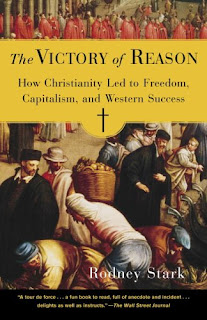
A Review of the "Victory of Reason" by Rodney Stark


Professor Rodney Stark is one of the world’s most renowned Sociologists of Religion. The full title of this book is "The Victory of Reason: How Christianity Led to Freedom, Capitalism, and Western Success". It received rave reviews in much of the American press. According the the Wall Street Journal the book is a “tour de force”. In his book, Stark argues that Christianity is responsible for reason, freedom, and science. He says that "the success of the West, including the rise of science, rested entirely on religious foundations, and the people who brought it about were devout Christians." In a startling counter-factual claim, Stark announces: "had the followers of Jesus remained an obscure Jewish sect, most of you would not have learned to read and the rest of you would be reading from hand-copied scrolls". Stark adds that if it wasn't for Jesus, we would live in a world where "most infants do not live to the age of five and many women die in childbirth". The argument is that science and freedom arose in Europe, and that Europe was Christian, therefore Christianity was responsible.

These are pretty strong claims for Christianity: the success of the West rests ENTIRELY on religious foundations, and all the people who brought it about were DEVOUT Christians. For Stark's thesis to stand, he needs to address several challenges to it, and unfortunately I think his book does not satisfactorily address those challenges.

1.
The first challenge facing Stark's thesis is the need to explain away the accomplishments of pre-Christian classical European civilisation - the achievements of Ancient Greece and Ancient Rome. Stark ascribes freedom, individualism, democracy, science and technology to Christianity, yet NOT ONE of these concepts is promulgated in the New Testament, but ALL of these concepts are strongly and clearly advocated in pre-Christian Ancient Greek thinkers.

The Ancient pre-Christian world of the West produced Homer, Aristotle, Plato, Sophocles, Archimedes, Hippocrates, Euclid, Galen, Cicero, Plautus. It somehow managed to do all of this without Jesus and without the Bible. Ancient Greece's leading thinkers were notable for their defence of reason, perhaps in contrast to the New Testament, which frequently instructs people to embrace "faith".

Stark's grasp of the achievements of the Ancient world is tenuous. He says that "Ultimately, Greek learning stagnated of its own inner logic [what does that mean?] . After Plato and Aristotle very little happened beyond some extensions of geometry". But some of the greatest work in Greek science, e.g. Ptolemy in geography and astronomy and Galen in medicine, took place over the four hundred years after Plato and Aristotle. How can Stark leave out Euclid, Archimedes, Ptolemy, Plotinus, Galen, Hipparchus, all of whom were writing in the centuries after Aristotle? Most historians of science give the Greeks precedence in science, but Stark says he knows of no real Greek achievements after Aristotle, which is when much of the greatest Greek work in science took place. If one wanted to be harsh, one could say that this level of ignorance disqualifies Stark from being taken seriously.

2.
The next challenge for Stark's thesis is to explain why Christian Medieval Europe was not obviously superior to the other great centres of Eurasian civilisation at that time, such as China, India and the Muslim world. Stark would also need to explain away the accomplishments of these non-Christian civilisations, which happened with little or no influence from Jesus or the Bible.

During the Middle Ages (from the fall of the Roman Empire in the 5th century to the beginning of the Early Modern period in the 16th century) Christianity dominated European intellectual life. One could argue that the civilisational accomplishments of Europe in this era were inferior to those of the Ancient European era that preceded it, as well as to the Modern European era that followed it. In fact, before the spread of the water-mill after 900 AD, Medieval Christian Western and Northern Europe contributed hardly anything in terms of innovation - and even between 1000 and 1450 the flow of philosophical ideas and technological innovations was predominantly from the Muslim world (and elsewhere) to Christian Europe, rather than vice versa. The reason for this? The non-Christian centres of Eurasian civilisation frequently had more to offer Christian Europe, than Christian Europe had to offer them.

To take the most obvious example, Medieval China was technologically more advanced than Christian Medieval Europe. China had invented the iron plough, matches, the compass, gunpowder, paper, printing - many of these technological advances only became known in Europe towards the end of the Christian Middle Ages. China's naval power was also superior to that of Europe during this period. All in all, China's cultural achievements (Confucianism, Taoism etc.) had not been noticeably inferior to those of anywhere else. China managed to accomplish all of this without Jesus and without the Bible.

Nevertheless, the Christian world did have some accomplishments during the thousand years of the Middle Ages, and it would be churlish not to recognise them. But it would also be churlish not to recognise that, when these accomplishments occurred, many of them were very strongly influenced by non-Christian sources. For example, the greatest Christian thinker of the Middle Ages (Aquinas) owed much to the pagan Aristotle and the Muslim Averroes - so much so that in his writings Aquinas referred to the former as simply The Philosopher, and the latter simply as The Interpreter. Aquinas's cosmopolitanism and open-mindedness to non-Christian sources is a refreshing contrast to Stark's blowhard "it-was-all-down-to-Jesus" nonsense.

Another point: if the West's supposed "innovation" and "superiority" in the Middle Ages can be attributed to Christianity, then why were the same "advances" not realised in the Byzantine east, where Christianity also reigned? In other words, any unusual advances (if they occurred) in Medieval Western Europe need to be explained by factors other than Christianity, since Byzantine Europe was also Christian.

3.
The next challenge facing Stark's thesis is to explain why Europe's rise to genuine global predominance after 1500 coincided with a marked DECLINE in Christianity's hold over European intellectual life. From the Sixteenth to the Twentieth Century, European technology and ideas advanced at such an exponential rate so as to virtually dominate the entire world. According to Stark the rise of Europe to global predominance was largely due to Jesus, the Bible and Christianity. But by the end of the Middle Ages, Christianity had been dominating Europe for over a thousand years, and Europe had not risen to global predominance.

What happened in the time after 1500? What happened was that Modern Europe emerged. The intellectual life of these centuries was marked by:
- the emergence of humanism
- the weakening of Christianity's intellectual authority
- the placing of pre-Christian classical learning on a more equal footing with Christian theology
- the emergence of secularism
- the increasing focus on naturalism
- the strengthening of science
- the increasing political separation of church and state
- the Enlightenment revolution in thought
- the notion that reason should be the source of authority rather than revealed religious texts, or church hierarchies.

It was during THIS period that Europe really did storm ahead of its competitors in terms of wealth, culture, science, and technology. And THIS period was marked, as I have said, by an increasing secularism and by the undeniable weakening of Christian intellectual authority in Europe.

4.
Yet another problem for Stark is the RESPONSE of Christianity to these new Modern European developments after 1500. Frequently it left a lot to be desired. The Catholic Church's index of banned books from this time almost reads like a Who's-Who of great Enlightenment thinkers: Descartes, Spinoza, Hobbes, Montesquieu, Hume, Locke, Voltaire, Rousseau, Diderot, Kant. In every case, the Catholic church banned all or some of their books. Other people on the list of banned books include Galileo, Kepler, Copernicus.

And what about the Protestant Christians? Calvin's Geneva had very little freedom of any sort, and was not a hotbed of modern innovation. As for Luther, his contribution to the defence of reason was to announce that "Reason is the Devil's greatest whore ... it ought to be trodden under foot and destroyed ... Reason should be destroyed in all Christians ... Whoever wants to be a Christian should tear the eyes out of his Reason."

So the most influential Christian thinker of the last 500 years was a vehement opponent of reason - this hardly strengthens Stark's case that Christianity is responsible for the "victory of reason".

The Christian churches often did what they could to retard the development of Modern Europe. In many ways they were a reactionary force - they defended superstition rather than reason. Stark's case for Christianity is comically overstated.

Overall, one might say this: during the Modern period, in so far as Christianity made itself compatible with the Enlightenment, Reason, Humanism and Science, then it did not retard European development. In so far as Christianity REJECTED Enlightenment, Reason, Humanism and Science then it did, indeed, try to retard European development.

CONCLUSION:

One well-known professor of sociology, Alan Wolfe, has described Stark's "The Victory of Reason" as "the worst book by a social scientist that I have ever read". Perhaps this is a bit extreme. But unfortunately Stark's bias and prejudice are obvious. This is not a balanced or objective work of history. Indeed, it is not intended to be balanced or objective. It is an exercise in vulgar apologetics, and its appeal will be limited almost entirely to insecure Christians who need to be told that they are better than everyone else.

The rise of Modern Europe to global predominance was largely caused by more prosaic factors than those put forward by Stark. For those interested in the real reasons, I would recommend Jared Diamond's "Guns, Germs and Steel" and Michael Cook's "A Brief History of the Human Race".


Wednesday, April 15, 2009

Is Muhammad more influential than Jesus?


In the below list of the history’s most influential people Muhammad comes in at number 1 whereas Jesus only makes number 3. Can this be justified? There are 2.1 billion Christians (about a third of the human race) compared to about 1.3 billion Muslims (about a quarter of the human race). So surely Jesus wins? Well, not necessarily. Jesus was the principle prophet of Christianity and Muhammad the principle prophet of Islam. But the primary text of Christianity (the Gospels) were written by Matthew, Mark, Luke and John, whereas the primary text of Islam (the Koran) was written by Muhammad. The primary missionary and proselytiser of Christianity was St. Paul, whereas the primary proselytiser of Islam was Muhammad. Muhammad is also a unique example of a political and military leader who was also a religious leader – he conquered much of the Middle East, and created his own Empire. On the other hand, Jesus let Julius Caesar and Augustus do the dirty work – they created the Roman Empire, and then Christianity took it over, when Constantine converted. So Mohammed is Jesus, Matthew, Mark, Luke, John, Paul, Julius Caesar, Augustus and Constantine all rolled into one. This is why he is the most influential human in history. The philosopher Nietzsche defined the Overman or Superman as “the Roman Caesar with the soul of Christ”. I submit that the prophet Mohammed was Nietzsche’s Overman – the prophet Mohammed was the Roman Caesar with the soul of Christ.

(PS: the above picture is of Muhammad Ali, rather than the prophet Muhammad)

Wednesday, March 25, 2009

There’s nothing wrong with having a bit of a tummy on you …


… not if you’re the Buddha, there isn’t.

“Do not dwell in the past, do not dream of the future, concentrate the mind on the present moment”

“Ennui has made more gamblers than avarice, more drunkards than thirst, and perhaps as many suicides as despair”

“It is better to conquer yourself than to win a thousand battles. Then the victory is yours. It cannot be taken from you, not by angels or by demons, heaven or hell.”

“In the sky, there is no distinction of east and west; people create distinctions out of their own minds and then believe them to be true.”

Kill the Buddha


My new-found obsession with Buddhism is now escalating into a very un-Buddhist like frenzy.

“Embrace nothing:
If you meet the Buddha on the way, kill the Buddha.
If you meet your kinfolk on the way, kill your kinfolk.
Only live your life as it is,
Not bound to anything.”

How cool is that!

Buddha


I wonder is there ANYTHING in what the Buddha said or did that any sane person could object to?

  • “Believe nothing, no matter where you read it, or who said it, no matter if I have said it, unless it agrees with your own reason and your own common sense.”
  • “Let us rise up and be thankful, for if we didn't learn a lot today, at least we learned a little, and if we didn't learn a little, at least we didn't get sick, and if we got sick, at least we didn't die; so, let us all be thankful.”
  • “Have compassion for all beings, rich and poor alike; each has their suffering.”
  • “He who experiences the unity of life sees his own Self in all beings, and all beings in his own Self, and looks on everything with an impartial eye.”
  • “No one saves us but ourselves. No one can and no one may. We ourselves must walk the path.”
  • “Thousands of candles can be lighted from a single candle, and the life of the candle will not be shortened. Happiness never decreases by being shared.”
  • “Work out your own salvation. Do not depend on others.”
  • “Hatred does not cease by hatred, but only by love; this is the eternal rule.”
  • “The only real failure in life is not to be true to the best one knows.”
  • “The whole secret of existence is to have no fear.”

"Cull the Living Flower"


“Religious suffering is, at one and the same time, the expression of real suffering and a protest against real suffering. Religion is the sigh of the oppressed creature, the heart of a heartless world, and the soul of soulless conditions. It is the opium of the people… The abolition of religion as the illusory happiness of the people is the demand for their real happiness….The criticism of religion is, therefore, in embryo, the criticism of that vale of tears of which religion is the halo….Criticism has plucked the imaginary flowers on the chain not in order that man shall continue to bear that chain without fantasy or consolation, but so that he shall throw off the chain and cull the living flower.” Karl Marx

Monday, January 19, 2009

“Your blog reminds me of diarrhoea” says misguided Richard Dawkins fan.

FLYING SPAGHETTI MONSTER WRITES: “Seeing the incredible volume of output on your blog this week, it is as if you've had years of constipation and now suddenly you've had a dose of the runs. Let it flow, let it flow, let it flow”
BB SAYS: Thank you for comparing my website to diarrhoea.

Your moniker appears to be a reference to Richard Dawkins, who uses the example of the Flying Spaghetti Monster to try and expose what he believes to be a fallacious argument sometimes used to defend belief in God. When atheists complain that the existence of God cannot be proven, believers sometimes reply that the existence of God cannot be disproven either, and that one should therefore believe in Him. According to Dawkins, this argument is an example of shifting the burden of proof. The burden of proof exists on the person who claims that a particular entity exists. It is not possible to prove a negative. Suppose I claim that a Flying Spaghetti Monster exists somewhere in outer space. You may object that I cannot prove that such an entity exists. I reply that you cannot disprove the existence of the Flying Spaghetti Monster either, and that therefore you should believe in It.

However, in my own opinion, Dawkins is guilty of using his own fallacy in this argument: the fallacy of false analogy. A Flying Spaghetti Monster would be a physical, material entity that exists in time and space. It would therefore be possible in principle to empirically verify the existence of the Flying Spaghetti Monster – by going and looking at it, for example. However, God is supposed to exist beyond time and space, outside of the physical, natural world. God is a supernatural entity, not a natural entity, like the Flying Spaghetti Monster. God transcends the phenomenal world. Because of this, it is not possible to empirically verify the existence of God. God is a fundamentally different type of entity to the Flying Spaghetti Monster. That is why belief in God tends to be based on faith, rather than evidence. When it comes to natural entities like the Flying Spaghetti Monster, we tend to demand empirical evidence for their existence. But for a supernatural entity like God, no such empirical evidence is possible, because God is a fundamentally different kind of entity. The religious virtues are faith, hope and love. The ability to spot an empirically verifiable hypothesis is a scientific virtue, not a religious one.

In any case, the multiverse is a VERY big, peculiar place, and there may well be Flying Spaghetti Monsters out there somewhere. If people want to believe in the Flying Spaghetti Monster, then I support their right to do so.

Do YOU have a problem? Leave an anonymous comment, or send your problem in confidence to brianbarrington@gmail.com

Wednesday, January 14, 2009

Reader asks God for help

READER ALEX WRITES: “I have just had a brief look at your website. God help us all”
BB SAYS: Interesting point Alex.

It only makes sense to appeal to God for help if you believe in an all-powerful, all-knowing God. But even that is not enough. If you believe in a Deistic God (who is indifferent to human beings and their destiny) then it makes no sense to petition him to help you. But if you believe in a Theistic God (one who is infinitely good, and concerned with your well-being) then it may make sense to petition him for help.

However, there is a problem with believing in a Theistic God, which is known by Philosophers and Theologians as The Problem of Evil. If God is omnipotent and omniscient, and also infinitely good, then why does he allow so much evil in the world? Why does he allow the innocent to suffer?.

Theologians have struggled with this problem for centuries. Some have argued that this world is, despite appearances, the best of all possible worlds. There may appear to be evil, but that is because human beings are incapable of understanding God’s mysterious ways. The innocent may sometimes suffer, but that suffering is ultimately necessary, even if we humans are not able to understand why. These are the arguments of some theologians.

Nevertheless, if one believes in an infinitely good, omnipotent and omniscient God, then one could still argue that there is no point in praying to Him for help– if he is omniscient then he already knows what help you need; if he is omnipotent then he already has the power to help you, and if he is infinitely good then he already wants to help you.

Given this, it would appear that your request to God to “help us all” is redundant. Perhaps we would be better off trying to help ourselves, rather than appealing to a hypothetical God.