Friday, February 12, 2010

Most Played Songs on My iTunes over the Last Year


I really have to bite the bullet here, and just come out with the truth, no matter how embarrassing. I wonder is there anyone out there who could do this honestly and not feel a little mortified about one or two of the songs that crop up? Anyway, here, in reverse order, are the twelve most played songs on my iTunes from last year. If you want to find out about the latest cutting edge music, er, you’re in the wrong place. But doing this is a revealing exercise. It’s a good way of finding out what music you really like, as opposed to what music you think you really like. I’m sure the below list reveals something about who I am. But what?

12. Wish You Were Here – Wyclef Jean

11. Crazy In Love – Beyonce

10. Mr Brightside - Killers

9. You Make it Easy – Air

8. Today – Smashing Pumpkins

7. Last Night – The Strokes

6. Paradise by the Dashboard Light - Meatloaf

5. There is a Light that Never Goes Out – The Smiths

4. At the River – Groove Armada

3. Nancy Boy – Placebo

2. Somewhere Only We Know – Keane (Sweet Jesus! This really is the second most listened to song on my iTunes! The evidence is there. There is no way to deny it. How is it possible that I have listened to this song more than, say, a masterwork like Meatloaf's “Paradise by the Dashboard Light”?)

1. Just Like Heaven – The Cure

Thursday, February 11, 2010

Greece: Making Ireland look good?


Speaking as a philosopher, it’s slightly disconcerting to watch the land of Socrates, Plato and Aristotle turned into an international laughing-stock. But speaking as an Irishman, I am relieved that the Greeks are distracting attention from us, and even making us look good, at least if “international perception” is anything to go by.

But what’s really going on here? The government deficit in Greece is about the same as Ireland’s – so the government in Ireland is over-spending by the same amount as the Greek government. So what’s the difference? Why so much fuss about Greece? Well, Ireland is starting from a lower total national debt, so the Irish government can afford to borrow these large amounts for a few more years, unlike the Greeks. So overall, Ireland is in a better position than Greece right?

Well, hang on a second there. Ireland’s national debt, its total GOVERNMENT debt, its PUBLIC debt, is less than Greece’s, as a proportion of GDP. All well and good. But a country’s TOTAL debt is public debt PLUS private debt. Ireland’s total external debt (public debt plus private debt owed to foreigners) is 1.8 trillion, as opposed to Greece’s, which is a mere 86 billion. So external debt per capita in Greece is $3,953, compared to $448,032 per head in Ireland.

http://en.wikipedia.org/wiki/External_debt_by_country

Now external debt is a complex thing, but these figures make the basic point quite clearly: Ireland’s PRIVATE debt is much, much, much higher than Greece’s. Overall, Ireland is more in debt to foreigners than Greece. The average Greek citizen is not imprisoned by private debt, unlike the average Irish citizen. This explains why the Greek populace is kicking up more of a stink than the Irish populace – their personal debt and household debt is much lower, so they are not debt slaves. As Ambrose Bierce once said “Debt is an ingenious substitute for the slave driver’s whip”. And a whole generation of young Irish people have been turned into debt slaves. Our best and brightest, our most dilligent and responsible young people, have been totally sold out.

Sure, the Greek government and public sector is making a total mess of things, but their private banks have not screwed things up – and that’s much more important. That’s not because Greek banks are really clever – it was just lethargy on their part. Clever bankers screw countries up - they make lots of money for themselves, and then get bailed out by everyone else. It has been Ireland’s misfortune to have lots of clever bankers.

Much of Ireland’s private debt will now be transferred into public debt – via NAMA and other mechanisms. This will cost a lot. My namesake Kathy Barrington of the "Sunday Business Post" reckons the Irish bank bailout will cost the state around 30 billion euro. That’s a conservative estimate. Morgan Kelly thinks more like 50 billion euro.

Much of Greece’s national debt has been financed by private Greek savings, in the same way that Japan’s has. That’s why Greek external debt is so small. Compared to Ireland, the Greeks don’t owe foreigners anything, because, unlike Ireland, they didn’t go on a deranged binge borrowing money from foreigners. In Ireland, the borrowing binge was spearheaded by Sean Fitzpatrick at Anglo-Irish Bank, and Michael Fingleton at Irish Nationwide, with the other banks eventually going along for the ride.

Book of the Year – The Bible


This long-awaited book did not disappoint. It’s got it all. Genocide. Incest. Torture. Tempestuous homosexual love-affairs. People coming back from the dead. Whatever it is you are into, you’ll find it somewhere in here. Not suitable for children though.

I thought that the first part of the Bible was the best. At the beginning of the second part of the book (called “The New Testament”) I felt the writer took a wrong turn, and presented us with a plot line so implausible it makes Tolkien’s “Lord of the Rings” look like a masterpiece of verisimilitude. And the lead character in this part of the book is such a loathsomely prissy goody two shoes that I find it impossible to believe he will hold much appeal for the general public.

So yeah. The Bible. A mixed bag. If you liked “Harry Potter” then you’ll love this. Definitely worth a look.

Wednesday, February 10, 2010

George Lee and Charlie Bird: Two tadpoles in a petri dish


So Charlie Bird went to Washington and didn’t like the sensation of being a small fish in a big pond. And George Lee went to the Dail and didn’t like the sensation of being a small fish in a puddle. So it appears they are both now attempting to swim their way back to RTE – where they can return to being two tadpoles in a petri dish.

Poor old George Lee couldn’t make up his mind which taxpayer’s tit he wanted to suck on (if you’ll excuse the shift in metaphor). Would he opt for the cosy gentlemen’s club of Dail Eireann, with its backslapping bonhomie and life of comfortable obscurity? Or would he opt for Montrose, where his sense of self-importance would be sustained by a compulsory yearly payment of 160 euro from every household in the country?

Who knows what will happen next? We’re all on the edge of our seats, waiting to see the next episode of this squalid national non-drama.

Tuesday, February 9, 2010

Welcome back

The blog is back! Just in time to miss the Irish Blog Awards for a second year running. But here’s the interesting thing: during its Sabbatical, this website got almost as many hits as it did when I was updating it on a daily basis. I find that remarkable. For example, on February the fifth 2010, for some bizarre reason, I got a MASSIVE amount of hits. Millions of them. Maybe even trillions of them. I don’t recall the exact figure but whatever it was, it was phenomenal. Now my question is: Why? Why did this happen on February 5th? What’s so great about February the 5th? Why, according to Google Analytics, did people in Zimbabwe, Mississippi, Oman, and Peru all suddenly decide to read this website on February the 5th?

And my other question is: why should I bother updating my website if I get almost as many hits when I don’t even bother my arse with it?

Well, here is the answer: the quantity of readers has not declined, but I suspect that the quality of the readers has. All I’ve been getting is freaks and fly-by-night fair-weather friends. In a bid to reverse this disturbing trend, I have decided to make a comeback. This website wants serious readers. This website wants readers who are worth having. This website, to put it frankly, wants YOU.

Over the next while I’ll be conducting a review of the previous year. So sit back, crack open a beer, give yourself a pat on the back, and enjoy the show.

My Year in Film


Avatar. James Cameron’s 3rd extravaganza. I felt like I was there! On Pandora in the Alpha Centauri star system! Looking for unobtanium! Avatar is even better than Titanic. And who would have thought that was possible? *[please see end of this post for acknowledgements]

The Men Who Stare at Goats. I went to see this because I wanted to see the latest Coen Brothers film. But, as Coen Brothers films go, I thought this one was disappointing and not up to their usual standards at all. And that’s because “The Men Who Stare At Goats” is not a Coen Brothers film. It’s by someone else. But I thought it was the Coen Brother’s latest film. I call that false advertising on the part of the people who were promoting this film. Except nobody advertised it as a Coen Brothers film. Anyway, it wasn’t until the film was over that I learned that this film has no connection whatsoever with the Coen Brothers. What else can I say about it? George Clooney is in it. It’s the worst film of the year. It’s about how crazy American right-wingers are – about how nuts they are. Well, we all know that already. We don’t need a film to tell us that American right-wingers are deluded and detached from reality.

Inglourious Basterds . The first scene is Tarantino at his best. Brilliant tension as the Gestapo dude interrogates the French guy. The rest of it is puerile, standard Tarantino fare.

Gran Torino – At this stage, Clint Eastwood is proving himself to be one of the great directors. This is the latest in a string of wonderful films from the world’s favourite tough guy.

Precious – I found this film deeply moving. And I haven’t even seen it. That’s how deeply, nay profoundly, moving this film is – you don’t even have to have seen it in order to be deeply moved by it. Incredible.

Film of the Year: It’s Complicated. In a mediocre year for films, “It’s Complicated” stood out as an instant classic. Three legendary actors at the top of the their game. And as for Meryl Streep. What can we say? Is there any role this woman cannot play? Such versatility! The film is laugh out loud funny. You could tell the audience was really enjoying it. I don’t understand why the reviews were so lacklustre.

Other Film of the Year. Looking for Eric. Britain’s greatest film director, Ken Loach, hits another bull's eye with this stunning portrayal of a troubled postman with an obsession with Eric Cantona. Really quite marvellous.

[* Acknowledgement: I would like to thank Michael Treacy for drawing my attention to the "unobtanium" cinematic trope and for trying to explain to me what a "cinematic trope" is, while drunk]

Wine of the Year: Rioja


Rioja doesn’t have any notions about itself. Unlike so many other wines, Rioja is not up its own arse. If you don’t like the superficial pizzazz of Italian wines, or the pretentious fussiness of French wines, or the plodding sameness of New World wines, then Rioja is the tipple for you. In many respects, I feel Rioja wines resemble this website. Rioja is uncomplicated yet substantial. It’s a serious wine. But it’s not humourless. I like my wines heavy, but agile and flexible. I want big fruity, flavours. I want the depth of oak. I want wines that bring me closer to nature. Rioja is not antiseptic. It’s not made by computers. It’s rough around the edges, but it’s also deeply civilised. It’s wild at heart, but it’s not completely out of control. I want wines that are simple, but not simplistic. I don’t want my wines to ask me too many questions, to set me too many challenges. I don’t want clever conversation. I don’t want to work that hard. I want a wine, not a crossword puzzle. I don’t like wines that are impertinent. A wine should not smack of adolescence. It should be solid rather than frivolous. It should be confident in itself. It should feel no need to go out of its way to impress. I don’t like wines that do little tap-dances, or that try to dazzle with summersaults. There’s nothing worse than an insecure wine. I like my wines to have been around the block. I want wines that have a scandalous history but a well-behaved, respectable present. But I don’t like my wines to be docile either. Nobody wants to drink a servile wine. Nobody wants a wine that has nothing to say for itself. Well, I reckon Rioja has it all. It has the balance just right. The wine of the year.

Thursday, April 30, 2009

World’s Most Livable Cities


The Mercer's Quality of Living Survey is released annually, and compares 215 cities based on 39 criteria such as safety, education, hygiene, recreation, political-economic stability and public transportation. The Germans have it sown up - German speaking countries dominate the list. 7 of the top 10 cities with the highest quality of life are in German speaking countries. Vienna (pictured above) is top of the list. Australia and Canada also do well. Dublin came in at 25. The most livable Asian city is Singapore, coming in at 26th. The United States struggles – its highest entries are Honolulu and San Fransico, which come in at joint 29th. 25 of the top 50 cities are European, compared to 7 of the top 50 for the US.

1 - Vienna, Austria
2 - Zurich, Switzerland
3 - Geneva, Switzerland
4 - Vancouver, Canada
5 - Auckland, New Zealand
6 - Düsseldorf, Germany
7 - Munich, Germany
8 - Frankfurt, Germany
9 - Bern, Switzerland
10- Sydney, Australia
11- Copenhagen, Denmark
12- Wellington, New Zealand
13- Amsterdam, The Netherlands
14- Brussels, Belgium
15- Toronto, Canada
16- Ottawa, Canada
17- Berlin, Germany
18- Melbourne, Australia
19- Luxembourg, Luxembourg
20- Stockholm, Sweden

Wednesday, April 29, 2009

Pigeon Annexes Reader's Balcony


A READER WRITES: "A pigeon has set up a nest on my balcony (see photograph), and I do not know what to do. Should I abort the eggs before they hatch? The father is also around, shitting all over my balcony. What should I do?"

BB SAYS: This is a tricky one. A friend of mine calls pigeons "rats with wings". Pigeons are notoriously ruthless - if you do not act now, they will take over your entire property. One option is to call in vermin control. But I would recommend taking matters into your own hands. Inoculate yourself against having any sympathy for the pigeons by watching Hitchcock's The Birds - this film will show you what's coming your way if you don't do the necessary.

The Great University Farce

The university as it currently exists has long outlived its usefulness. We should get rid of universities, and replace them with something else.

People are finally beginning to blow the whistle of the Great University Farce. The dirty little secret is this: most people employed by universities are mediocre and don’t do anything useful. According to the New York Times:

“Most graduate programs universities produce a product for which there is no market (candidates for teaching positions that do not exist) and develop skills for which there is diminishing demand (research in subfields within subfields and publication in journals read by no one other than a few like-minded colleagues), all at a rapidly rising cost (sometimes well over $100,000 in student
loans)”
Also, due to excessive specialisation, most academics have a "limited knowledge that all too often is irrelevant for genuinely important problems".

The whole thing is a pyramid scheme: "young people enroll in graduate programs, work hard for subsistence pay and assume huge debt burdens, all because of the illusory promise of faculty appointments".

Swine Flu Histrionics


Frequent outbursts of irrational hysteria are one of the human species most charming characteristics. Remember when the cows went mad a few years ago? That was an enjoyable one. “BSE has the potential to infect up to 10 million Britons” crowed one “scientific expert”. Then there was SARS – there was "a 25% chance of killing tens of millions" according to one “scientific expert”. Then there was bird flu – “it will be the first pandemic of the 21st century" said another “scientific expert”. "One in four Britons could die" said the World Health Organisation.

Now the world is going mad over “Swine Flu”. Swine flu – sounds sinister and dangerous. What is swine flu? As Simon Jenkins points out in today's Guardian, Swine flu is flu. If you get it you go to bed for a while and take some medicine. Then you get well again, unless you are very unlucky. A couple from the UK who caught the swine flu on holiday in Cancun are getting better. That tends to happen to people who get flu, however much it may disappoint the media.

Anyway, don’t let the facts prevent you from going barking mad and worrying about Swine Flu – humans love to go berserk for no reason. Join in the fun! Get yourself a face mask and a germ warfare suit! The “experts” will be hauled out in front of TV cameras to intone about how “500 billion people could die from this … so give me and the health organisations more money”.

Anyone for Sheep Flu?

(Of course, when Swine Flu becomes a global pandemic and millions of people die, I’m going to feel a bit guilty about writing the above post)

Friday, April 24, 2009

Polly Toynbee on the UK budget

"Is this a people's budget? It did soak the rich - just listen to their indignation. The 1.5% who earn over £100,000 will yet again claim an assault on "middle England" [due to taxes being raised on their incomes]. They will protest that productivity, growth, aspiration and the very future of the nation will be imperilled by skimming just a little cream off top earners. They will warn that City talent will now take flight, the golden geese fleeing to Zurich, Monaco or Dubai. At last, so late in the day, Labour has called their bluff: let them go. There is no global shortage of those who ran banks into the ground."

"My daughter is a lesbian"

A READER WRITES: "I recently discovered to my shock that my daughter is a lesbian. What should I do?"
BB SAYS: You should do nothing. This page is for people who have problems that need to be solved. Your daughter being a lesbian is NOT a problem.

Do YOU have a problem? Leave an anonymous comment, or send your problem in confidence to brianbarrington@gmail.com

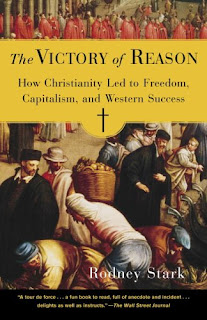
A Review of the "Victory of Reason" by Rodney Stark


Professor Rodney Stark is one of the world’s most renowned Sociologists of Religion. The full title of this book is "The Victory of Reason: How Christianity Led to Freedom, Capitalism, and Western Success". It received rave reviews in much of the American press. According the the Wall Street Journal the book is a “tour de force”. In his book, Stark argues that Christianity is responsible for reason, freedom, and science. He says that "the success of the West, including the rise of science, rested entirely on religious foundations, and the people who brought it about were devout Christians." In a startling counter-factual claim, Stark announces: "had the followers of Jesus remained an obscure Jewish sect, most of you would not have learned to read and the rest of you would be reading from hand-copied scrolls". Stark adds that if it wasn't for Jesus, we would live in a world where "most infants do not live to the age of five and many women die in childbirth". The argument is that science and freedom arose in Europe, and that Europe was Christian, therefore Christianity was responsible.

These are pretty strong claims for Christianity: the success of the West rests ENTIRELY on religious foundations, and all the people who brought it about were DEVOUT Christians. For Stark's thesis to stand, he needs to address several challenges to it, and unfortunately I think his book does not satisfactorily address those challenges.

1.
The first challenge facing Stark's thesis is the need to explain away the accomplishments of pre-Christian classical European civilisation - the achievements of Ancient Greece and Ancient Rome. Stark ascribes freedom, individualism, democracy, science and technology to Christianity, yet NOT ONE of these concepts is promulgated in the New Testament, but ALL of these concepts are strongly and clearly advocated in pre-Christian Ancient Greek thinkers.

The Ancient pre-Christian world of the West produced Homer, Aristotle, Plato, Sophocles, Archimedes, Hippocrates, Euclid, Galen, Cicero, Plautus. It somehow managed to do all of this without Jesus and without the Bible. Ancient Greece's leading thinkers were notable for their defence of reason, perhaps in contrast to the New Testament, which frequently instructs people to embrace "faith".

Stark's grasp of the achievements of the Ancient world is tenuous. He says that "Ultimately, Greek learning stagnated of its own inner logic [what does that mean?] . After Plato and Aristotle very little happened beyond some extensions of geometry". But some of the greatest work in Greek science, e.g. Ptolemy in geography and astronomy and Galen in medicine, took place over the four hundred years after Plato and Aristotle. How can Stark leave out Euclid, Archimedes, Ptolemy, Plotinus, Galen, Hipparchus, all of whom were writing in the centuries after Aristotle? Most historians of science give the Greeks precedence in science, but Stark says he knows of no real Greek achievements after Aristotle, which is when much of the greatest Greek work in science took place. If one wanted to be harsh, one could say that this level of ignorance disqualifies Stark from being taken seriously.

2.
The next challenge for Stark's thesis is to explain why Christian Medieval Europe was not obviously superior to the other great centres of Eurasian civilisation at that time, such as China, India and the Muslim world. Stark would also need to explain away the accomplishments of these non-Christian civilisations, which happened with little or no influence from Jesus or the Bible.

During the Middle Ages (from the fall of the Roman Empire in the 5th century to the beginning of the Early Modern period in the 16th century) Christianity dominated European intellectual life. One could argue that the civilisational accomplishments of Europe in this era were inferior to those of the Ancient European era that preceded it, as well as to the Modern European era that followed it. In fact, before the spread of the water-mill after 900 AD, Medieval Christian Western and Northern Europe contributed hardly anything in terms of innovation - and even between 1000 and 1450 the flow of philosophical ideas and technological innovations was predominantly from the Muslim world (and elsewhere) to Christian Europe, rather than vice versa. The reason for this? The non-Christian centres of Eurasian civilisation frequently had more to offer Christian Europe, than Christian Europe had to offer them.

To take the most obvious example, Medieval China was technologically more advanced than Christian Medieval Europe. China had invented the iron plough, matches, the compass, gunpowder, paper, printing - many of these technological advances only became known in Europe towards the end of the Christian Middle Ages. China's naval power was also superior to that of Europe during this period. All in all, China's cultural achievements (Confucianism, Taoism etc.) had not been noticeably inferior to those of anywhere else. China managed to accomplish all of this without Jesus and without the Bible.

Nevertheless, the Christian world did have some accomplishments during the thousand years of the Middle Ages, and it would be churlish not to recognise them. But it would also be churlish not to recognise that, when these accomplishments occurred, many of them were very strongly influenced by non-Christian sources. For example, the greatest Christian thinker of the Middle Ages (Aquinas) owed much to the pagan Aristotle and the Muslim Averroes - so much so that in his writings Aquinas referred to the former as simply The Philosopher, and the latter simply as The Interpreter. Aquinas's cosmopolitanism and open-mindedness to non-Christian sources is a refreshing contrast to Stark's blowhard "it-was-all-down-to-Jesus" nonsense.

Another point: if the West's supposed "innovation" and "superiority" in the Middle Ages can be attributed to Christianity, then why were the same "advances" not realised in the Byzantine east, where Christianity also reigned? In other words, any unusual advances (if they occurred) in Medieval Western Europe need to be explained by factors other than Christianity, since Byzantine Europe was also Christian.

3.
The next challenge facing Stark's thesis is to explain why Europe's rise to genuine global predominance after 1500 coincided with a marked DECLINE in Christianity's hold over European intellectual life. From the Sixteenth to the Twentieth Century, European technology and ideas advanced at such an exponential rate so as to virtually dominate the entire world. According to Stark the rise of Europe to global predominance was largely due to Jesus, the Bible and Christianity. But by the end of the Middle Ages, Christianity had been dominating Europe for over a thousand years, and Europe had not risen to global predominance.

What happened in the time after 1500? What happened was that Modern Europe emerged. The intellectual life of these centuries was marked by:
- the emergence of humanism
- the weakening of Christianity's intellectual authority
- the placing of pre-Christian classical learning on a more equal footing with Christian theology
- the emergence of secularism
- the increasing focus on naturalism
- the strengthening of science
- the increasing political separation of church and state
- the Enlightenment revolution in thought
- the notion that reason should be the source of authority rather than revealed religious texts, or church hierarchies.

It was during THIS period that Europe really did storm ahead of its competitors in terms of wealth, culture, science, and technology. And THIS period was marked, as I have said, by an increasing secularism and by the undeniable weakening of Christian intellectual authority in Europe.

4.
Yet another problem for Stark is the RESPONSE of Christianity to these new Modern European developments after 1500. Frequently it left a lot to be desired. The Catholic Church's index of banned books from this time almost reads like a Who's-Who of great Enlightenment thinkers: Descartes, Spinoza, Hobbes, Montesquieu, Hume, Locke, Voltaire, Rousseau, Diderot, Kant. In every case, the Catholic church banned all or some of their books. Other people on the list of banned books include Galileo, Kepler, Copernicus.

And what about the Protestant Christians? Calvin's Geneva had very little freedom of any sort, and was not a hotbed of modern innovation. As for Luther, his contribution to the defence of reason was to announce that "Reason is the Devil's greatest whore ... it ought to be trodden under foot and destroyed ... Reason should be destroyed in all Christians ... Whoever wants to be a Christian should tear the eyes out of his Reason."

So the most influential Christian thinker of the last 500 years was a vehement opponent of reason - this hardly strengthens Stark's case that Christianity is responsible for the "victory of reason".

The Christian churches often did what they could to retard the development of Modern Europe. In many ways they were a reactionary force - they defended superstition rather than reason. Stark's case for Christianity is comically overstated.

Overall, one might say this: during the Modern period, in so far as Christianity made itself compatible with the Enlightenment, Reason, Humanism and Science, then it did not retard European development. In so far as Christianity REJECTED Enlightenment, Reason, Humanism and Science then it did, indeed, try to retard European development.

CONCLUSION:

One well-known professor of sociology, Alan Wolfe, has described Stark's "The Victory of Reason" as "the worst book by a social scientist that I have ever read". Perhaps this is a bit extreme. But unfortunately Stark's bias and prejudice are obvious. This is not a balanced or objective work of history. Indeed, it is not intended to be balanced or objective. It is an exercise in vulgar apologetics, and its appeal will be limited almost entirely to insecure Christians who need to be told that they are better than everyone else.

The rise of Modern Europe to global predominance was largely caused by more prosaic factors than those put forward by Stark. For those interested in the real reasons, I would recommend Jared Diamond's "Guns, Germs and Steel" and Michael Cook's "A Brief History of the Human Race".


Thursday, April 23, 2009

What is the meaning of life?


A READER WRITES: “You keep on referring to the philosophy of Epicurus, the philosophy of Socrates, the philosophy of Nietzsche and so on. But what is your own philosophy? What do you think is the meaning of life? I want answers. I want to know what you think yourself. Don’t fob us off with ‘Hegel says ….’”

BB SAYS: My answer is embarrassingly simple. This is because I think that the answer to your questions is quite simple. So if you are looking for something devastatingly exciting, revelatory and original then I’m afraid you will not find it here.

So what is the meaning of life? The purpose of human life is happiness. This is what all human beings aim to achieve. Happiness and Joy are a by-product of certain human activities. So happiness is an activity rather than a state. The activities that bring us happiness and joy are based on our human nature – we are happy when we exercise various human faculties. I divide our human nature into three key components.

1.
Bodily life. Human beings are animals. We have the characteristics of mammals: sleeping, resting, breathing, eating, drinking, sex, reproducing, moving our bodies (dancing, running, climbing etc), sensory perception, growth. Participating in these activities brings us joy. Also, we are tool using animals, so making things can also bring us joy.

2.
Social life. Human beings are social animals. We live in groups. We live with other people. So social activities bring us joy. These include: love, friendship, family, parenting, laughing with others, helping other people. As well as being co-operative animals we are also competitive animals. We seek status in our social groups – via popularity, influence, wealth, fame or power. The pursuit and attainment of these things can also bring joy. But social status is a zero-sum game. There is only a fixed amount to go around. More for one person means less for another person. This “zero-sum” characteristic means that the quest for status is in many respects the most problematic part of human nature, since it leads to conflicts of interest, in a way that the others do not.

3.
Contemplative life. Human beings have evolved exceptionally large and complex brains. We are contemplative beings. We are curious animals, and the acquisition and discovery of knowledge is a joyful experience for us – whether in the form of science, psychology, history, philosophy and so forth. We also have aesthetic experiences (nature, art, music, literature) – so these are also a source of joy. Meditation, spirituality and religion are also components of this contemplative aspect of our nature, and they can also be a source of joy and happiness for many people.

Now whilst the basic structure of human nature is the same for nearly every human being, there are variations. Some people are more intellectual and contemplative, some are more religious and spiritual, some are more artistic and creative, some more sociable, some more competitive amd ambitious, some are more active, and some are more sensory and focused on the pleasures of the body. So each human being should work out what type of person he or she is, and act accordingly in order to live the most joyful life s\he possibly can. Thus the dictum: Know Thyself.

Do YOU have a problem? Leave an anonymous comment, or send your problem in confidence to brianbarrington@gmail.com

Wednesday, April 22, 2009

The biggest theft in the history of humanity

Mark my words: what is going on now with the bailouts of financial institutions will one day be clearly seen for what it really is – the biggest theft in the history of humanity. The money is being stolen off you and me - and off our children and grandchildren - in the form of higher taxes and higher future taxes. This is being done in order to bailout financial institutions that have made estimated world-wide losses of 4.1 trillion dollars (according to the IMF) - ) – “The next estimate will presumably be higher” notes Martin Wolf of the Financial Times dryly. The financial institutions knowingly took the risks that led to these losses, because they knew that they would be bailed out when things went wrong, and because they knew that the people who run the banks would make personal fortunes before the bailout became necessary.

Where is the biggest bank bailout theft occurring? Here in Ireland. According to the IMF, Ireland will pay a higher price (proportionately) to stabilise its banks than any other developed country in the world. This is because Ireland had a bigger property boom than anywhere else, and so there are more bad debts here than anywhere else. Thus, young people in Ireland will have to continue paying off the most over-priced mortgages in the world – but they will also face huge increases in taxes in order to fund the largest bank bailout in the world. Many people will start to ask themselves: Is there any point in staying in this country? And this is not just my opinion – it is the opinion of twenty of Ireland’s leading academic economists, all of whom think that the current proposed government bailout of Irish banks is basically a disguised rip-off of the Irish tax-payer. These 20 economists think that the government should nationalise the banks – so that the tax-payer might at least have the possibility of getting something in return for his money.

But remember that the governments of developed countries, including Ireland, have one objective: to give these financial institutions as much of your money as they possibly can, with a minimum of fuss, and without nationalisation. The IMF expressed concern that taxpayers were becoming weary of supporting the financial sector: “There is a real risk that governments will be reluctant to allocate enough resources” it fretted. Personally, I think the IMF is worrying for no reason: the public objects to these bailouts, but the governments will just ignore those objections. The bankers will not give back the money they made during years of illusory profits. They will just take our money now, in order to cover their losses.

So why do the banks need to be bailed out with your money? The official answer is that there is a “shortage of credit”. If the banks are not bailed out there will be no lending, so the story goes. This is rubbish.

If governments really wanted to increase “credit” here is what they would do: set up new state-owned banks using the money that they are giving to the existing banks OR nationalise the systemically important parts of the existing banks. But they wish to avoid nationalisation at all costs. By giving your money to the existing banks, governments are ensuring that your money will be used to write off the bad debts of those banks, rather than to “expand credit”. The purpose is to use your money to keep the existing institutions in tact, with as many of the same people in charge as is possible. And remember that the REAL problem with the world economy is not a shortage of credit – it is a shortage of demand.

The rest of us can go screw ourselves while the bankers laugh at us because we let them steal our money.

Will the government continue to treat you with contempt by refusing to nationalise the banks? Will you vote for them if they continue to treat you like this?

Tuesday, April 21, 2009

Why does Obama do what the banks tell him to do?


Leading Noble Prize winning economists like Paul Krugman and Joseph Stiglitz say banks should be nationalised. But when Obama has an economic summit to decide what to do, people like Krugman and Stiglitz are nowhere to be seen. Why not? Noam Chomsky explains why:

Obama’s plan is the same the Bush plan - it's based on the principle that the financial institutions should remian intact, no matter how much it costs taxpayers. They have to remain intact, and must remain under the control of the same people who destroyed the economy. Why?

Obama’s constituency is basically the financial institutions. Just take a look at the funding for his campaign. I mean, the final figures haven't come out, but we have preliminary figures, and it seems to be mostly financial institutions. I mean, the financial institutions preferred him to McCain. They are the main funders for both—you know, I mean, core funders for both parties, but considerably more to Obama than McCain ... That's the way the system works: you make risky loans, you make a lot of money, and if you get into trouble, we're here to bail you out, namely the taxpayer … What does ‘too big to fail’ mean? ‘Too big to fail’ is an insurance policy. It's a government insurance policy. Government means the public pays, which says, ‘You can take huge risks and make plenty of profit, and if anything goes wrong, we'll bail you out.’ That's ‘too big to fail.’ Well, that's extreme protectionism … We lectured the third world that they must accept free trade, though we accept protectionism.”

“The modern information revolution—computers, the internet, fancy software and so on—most of that comes straight out of the Pentagon. My own university, MIT, was one of the places where all of this was developed under Pentagon contracts in the 1950s and the 1960s. In fact, that's another critical part of the way the economy works. The public pays the costs and takes the risk of economic development, and if anything works, maybe decades later, it's handed over to private enterprise to make the profits. And that's a core element of the economy. Of course, we don't permit the third world to do that. That's considered a violation of free trade when they do it. But it's the way our economy works. And it's kind of complementary to the ‘too big to fail’ doctrine of protectionism for financial institutions. But in general—we do not have a capitalist economy. We have kind of a state capitalist economy in which the public has a role: pay the costs, take the risks, bail out if they get into trouble. And the private sector has a role: make profit, and then turn to the public if you get into trouble”.

Wednesday, April 15, 2009

Is Muhammad more influential than Jesus?


In the below list of the history’s most influential people Muhammad comes in at number 1 whereas Jesus only makes number 3. Can this be justified? There are 2.1 billion Christians (about a third of the human race) compared to about 1.3 billion Muslims (about a quarter of the human race). So surely Jesus wins? Well, not necessarily. Jesus was the principle prophet of Christianity and Muhammad the principle prophet of Islam. But the primary text of Christianity (the Gospels) were written by Matthew, Mark, Luke and John, whereas the primary text of Islam (the Koran) was written by Muhammad. The primary missionary and proselytiser of Christianity was St. Paul, whereas the primary proselytiser of Islam was Muhammad. Muhammad is also a unique example of a political and military leader who was also a religious leader – he conquered much of the Middle East, and created his own Empire. On the other hand, Jesus let Julius Caesar and Augustus do the dirty work – they created the Roman Empire, and then Christianity took it over, when Constantine converted. So Mohammed is Jesus, Matthew, Mark, Luke, John, Paul, Julius Caesar, Augustus and Constantine all rolled into one. This is why he is the most influential human in history. The philosopher Nietzsche defined the Overman or Superman as “the Roman Caesar with the soul of Christ”. I submit that the prophet Mohammed was Nietzsche’s Overman – the prophet Mohammed was the Roman Caesar with the soul of Christ.

(PS: the above picture is of Muhammad Ali, rather than the prophet Muhammad)

The 100 Most Influential People in History


A book has been written, ranking the most influential 100 people in human history. Below are the top 30 most influential people. I have my doubts about the list. Einstein in the top 10? What did Einstein ever do? His so-called theory of so-called relativity makes absolutely no sense whatsoever, if you ask me. And why is Christopher Columbus at number 9? Because he "discovered" America hundreds of years after the Vikings, and thousands of years after the Native Americans? Big deal.

1. Muhammad
2. Isaac Newton
3. Jesus Christ
4. Buddha
5. Confucius
6. St. Paul
7. Ts'ai Lun (inventor of paper)
8. Johann Gutenberg (developed movable type)
9. Christopher Columbus
10. Albert Einstein
11. Louis Pasteur (invented pasteurization)
12. Galileo Galilei
13. Aristotle
14. Euclid
15. Moses
16. Charles Darwin
17. Emporer Qin (unified China)
18. Augustus Caesar
19. Nicolaus Copernicus
20. Antoine Laurent Lavoisier (beheaded during the French revolution for being a chemist)
21. Constantine the Great
22. James Watt (developed steam engine)
23. Michael Faraday (discovery of magneto-electricity, boring git)
24. James Clerk Maxwell (discovered the electromagnetic spectrum – who cares?)
25. Martin Luther
26. George Washington
27. Karl Marx
28. The Wright Brothers (inventors of airplane)
29. Genghis Khan
30. Adam Smith

Tuesday, April 14, 2009

Slavery and Fear of Death


"The man who is not afraid to die will always be your master." - Seneca, the Roman Stoic philosopher.

A corollary: Fear of death is what enslaves a person, and a person who is not afraid of death cannot be enslaved. Given that death is inevitable, it could be argued that to let one’s life be determined by fear of death is the most irrational thing in the world.

The above painting is “The Death of Seneca” by Rubens. Seneca was accused of treason by the Emperor Nero and was forced to commit suicide.

Other quotes by Seneca:

“Life without the courage for death is slavery”

“He who is brave is free”

“Men do not care how nobly they live, but only how long, although it is within the reach of every man to live nobly, but within no man's power to live long.”

“Death is the release from all pain and complete cessation, beyond which our suffering will not extend. It will return us to that condition of tranquility, which we had enjoyed before we were born. Should anyone mourn the deceased, then he must also mourn the unborn. Death is neither good nor evil, for good or evil can only be something that actually exists. However, whatever is of itself nothing and which transforms everything else into nothing will not all be able to put us at the mercy of Fate.”

“Religion is regarded by the common people as true, by the wise as false, and by rulers as useful.”